Nina Paley es una dibujante estadounidense, animadora y activista de la cultura libre.
“Seder-Masochism” es un musical animado que sigue libremente la
historia de la Pascua Seder, con eventos del Libro del Éxodo contados por
Moisés, Aarón, el Ángel de la Muerte, Jesús y el padre del director. La
película da un giro a la historia bíblica tradicional al incluir una
perspectiva de deidad femenina: la Diosa, en una trágica lucha contra las
fuerzas del patriarcado.
"Sita Sings the Blues" está basada en la épica
hindú "El Ramayana". Sita es una diosa separada de su amado señor y
esposo, Rama. Nina Paley es una animadora cuyo esposo se muda a la India y
luego la deja por correo electrónico. Tres hilarantes títeres de sombras narran
tanto la tragedia antigua como la comedia moderna en esta interpretación
bellamente animada del Ramayana. Ambientada con la fogosa voz de la cantante de
jazz de los años 20 Annette Hanshaw, "Sita Sings the Blues", se gana
su lema como "la mejor historia de rupturas jamás contada". Está
escrita, dirigida, producida y animada por la artista estadounidense Nina
Paley.
Cuando
la fotógrafa Isa Leshko conoció por primera vez a un caballo pinto de 34 años
llamado Petey, hubo algo en el amable y artrítico Appaloosa que la cautivó. Sus
ojos estaban nublados por las cataratas, su capa era opaca y áspera, y se movía
rígidamente mientras la seguía por el pasto. Hipnotizada por el gentil animal,
Leshko corrió adentro para agarrar su cámara. "No estaba segura de por qué
me sentía tan atraída por él, pero seguía tomando fotos. Había pasado mucho
tiempo desde la última vez que había sentido este tipo de emoción mientras
sostenía una cámara", dice Leshko. Leshko y su hermana habían estado cuidando
a su padre, que había luchado con éxito contra el cáncer oral en etapa 4, y a
su madre, que padecía de Alzheimer en estado avanzado. "Cuando revisé mis
negativos de mi tarde con Petey, me di cuenta de que había encontrado una
manera de examinar mi dolor y mi miedo derivados de la enfermedad de mamá, y
sabía que tenía que encontrar otros animales mayores para fotografiar",
dice Leshko. "No estaba pensando en embarcarme en un proyecto a largo
plazo. Estaba buscando la catarsis". Más de una década después, ese
encuentro con Petey ha dado como resultado el inquietante libro de Leshko,
"Permitido envejecer: retratos de animales ancianos de los santuarios
agrícolas" (University of Chicago Press, 2019). El trabajo presenta
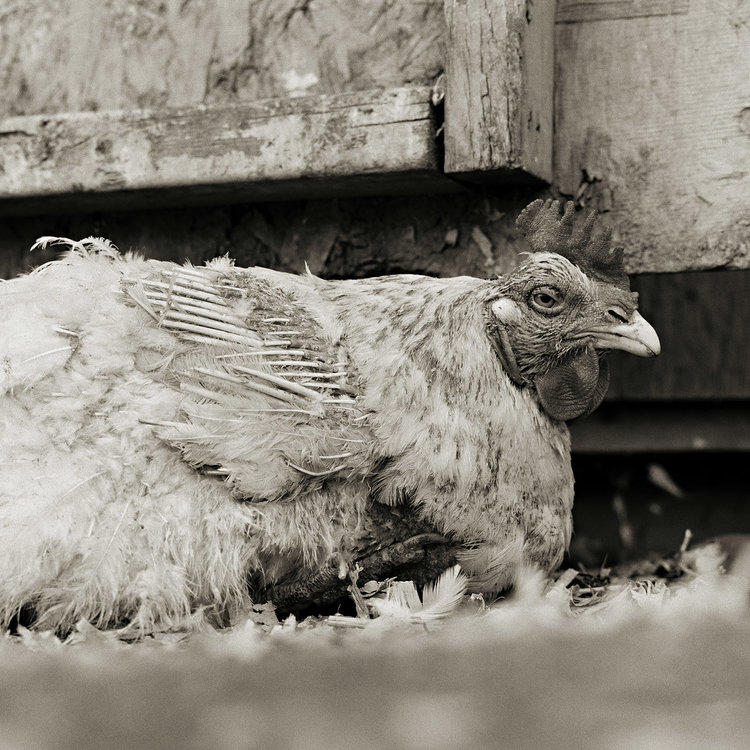
imágenes de caballos, vacas, pollos, cabras, cerdos y otros animales de granja
que han sido rescatados y viven sus últimos días en condiciones de seguridad.
"La experiencia tuvo un profundo efecto en mí y me obligó a enfrentar mi
propia mortalidad", dice Leshko. "Estoy aterrorizada de envejecer, y
comencé a fotografiar animales ancianos para observar este miedo. Cuando conocí
a animales de granja rescatados y escuché sus historias, sin embargo, mi
motivación para crear este trabajo cambió. Me apasioné al abogar por estos
animales, y quería usar mis imágenes para hablar en su nombre".
Los
afortunados
Violet, el cerdo barrigón, nació parcialmente paralizado.
(Foto: Isa Leshko/'Permitido envejecer'). Los animales fotografiados por Leskko
vivían en santuarios de animales en todo el país. Algunos habían sido
abandonados durante tormentas u otros desastres naturales. Otros fueron
rescatados de acaparadores u operaciones agrícolas de traspatio. Algunos fueron
encontrados deambulando por las calles después escapar camino al matadero. Unos
pocos eran mascotas cuyos dueños ya no podían cuidar de ellos. "Casi todos
los animales de granja que conocí para este proyecto sufrieron horribles abusos
y negligencias antes de su rescate. Sin embargo, es un eufemismo masivo decir
que son los afortunados", dice Leshko. Y como Melissa observó en
Treehugger, "La cuestión es que no tenemos la oportunidad de conocer
muchos animales viejos". "Aproximadamente 50 mil millones de animales
terrestres son criados en granjas en todo el mundo cada año. Es un milagro
estar en presencia de un animal de granja que ha logrado llegar a la vejez. La
mayoría de sus parientes mueren antes de los 6 meses. Representando la belleza
y la dignidad de los animales de granja de edad avanzada, invito a la reflexión
sobre lo que se pierde cuando a estos animales no se les permite envejecer".
Memorias dolorosas
Las imágenes a menudo eran emocionalmente difíciles de tomar
para Leshko. "Lloré mientras fotografiaba animales, particularmente
después de enterarme de los horribles traumas que sufrieron antes de ser rescatados",
dice. "A veces un animal me recordaba a mi madre, que también fue
doloroso". En la introducción del libro, Leshko describe el encuentro con
un pavo ciego que, según ella, se parece a su madre después de volverse
catatónica: "Uno de los animales que conocí para este proyecto fue un pavo
ciego llamado Gandalf que vivía en "Pasado's Safe Haven" en Sultan,
Washington. Debido a que era ciego, sus ojos a menudo tenían una cualidad en
blanco. Era un día insoportablemente bochornoso cuando lo conoció por primera
vez y Gandalf, como la mayoría de los pavos, se refrescaba al respirar con el
pico abierto", escribe. "Su mirada vacía junto con su boca abierta me
transportó al lado de la cama de mi madre durante sus últimos meses, cuando
ella estaba catatónica. Huí del recinto de Gandalf llorando después de pasar
unos momentos con él. Tomó algunas visitas más antes de que finalmente pudiera
ver a Gandalf y no a mi madre cuando lo miraba a través de mi visor. Me
sorprendió la naturaleza gentil y digna del pájaro, y me concentré en estos
atributos mientras lo fotografiaba".
Impacto emocional
Los retratos amables y majestuosos de Leshko a menudo tienen
un gran impacto en las personas que los ven. "Mucha gente llora. He
recibido cientos de correos electrónicos profundamente personales de personas
de todo el mundo, compartiendo conmigo su dolor por un padre moribundo o una
querida mascota enferma", dice. "En las inauguraciones de
exposiciones, recibo habitualmente abrazos de extraños que comparten con
lágrimas sus historias de pérdida. Estoy profundamente conmovida porque mi
trabajo ha afectado a las personas en un nivel tan emocional. Estoy agradecida
por la efusión de amor y apoyo que he recibido para este trabajo. Pero a veces
estos encuentros también han sido dolorosos, especialmente cuando ocurrieron
mientras lloraba la muerte de mis padres". Las imágenes también han sido
terapéuticas para Leshko. "Pasar tiempo con animales de granja que han
desafiado todas las probabilidades de llegar a la vejez me ha recordado que el envejecimiento
es un lujo, no una maldición", dice Leshko. "Nunca dejaré de tener
miedo de lo que me depara el futuro pero quiero enfrentar mi eventual declive
con el mismo estoicismo y gracia que los animales en estas fotografías han
mostrado".
Sin pestañear, en detalle
Al fotografiar a sus sujetos mayores, Leshko dice que quería
que fueran "inquebrantables en detalle" pero no fríos o crueles.
Fotografió a la mayoría de los animales mientras yacía en el suelo a su nivel
en un granero o pasto para que se sintieran más cómodos. "Los humanos son
conscientes de su edad y apariencia de una manera que los animales no lo
son", dice ella. "Esta es una de las razones por las que no había
fotografiado a mi madre durante sus años de declive. Antes de su enfermedad, mi
madre estaba muy preocupada por su apariencia y se esforzaba por verse mejor
antes de salir en público". Los animales tienen diferentes razones para
ocultar los signos del envejecimiento. "Algunos animales ocultan los
signos de la enfermedad o se camuflan para evitar ser presas fáciles. Muchas
especies alteran su apariencia física para atraer a sus parejas. Pero eso no
significa que los animales sean conscientes de su apariencia de la misma manera
que los humanos" dice. "Sin embargo, al editar mis imágenes para este
proyecto, consideré cuidadosamente si las imágenes que seleccioné eran
respetuosas con los animales que había fotografiado". Aunque iluminé sus
ojos para aumentar los detalles, hice poco para cambiar lo que fotografié.
"Muchos de los animales que conocí habían perdido muchos dientes y
babeaban mucho. Luché sobre si incluir baba en mis imágenes, editarlas en
Photoshop o elegir una imagen completamente diferente. Decidí incluirlo en mis
imágenes porque no quería imponer normas antropocéntricas a estos animales.
Quería respetar el hecho de que mis sujetos son animales, no humanos, y no son
humanos en pieles y plumas".
Testamentos para la supervivencia y la resistencia
La mayoría de los animales que aparecen en el libro de
Leshko murieron entre seis meses y un año después de que los fotografiara. En
algunos casos, un animal murió el día después de que lo conociera. "Estas
muertes no son sorprendentes dada la naturaleza de este proyecto y sin embargo
han sido dolorosas". Desde que comenzó el proyecto, sus padres
fallecieron, perdió dos gatos domésticos por cáncer y una amiga cercana murió
después de una caída. "El dolor inicialmente inspiró este trabajo y ha
sido mi compañero constante mientras he trabajado en este libro", dice
Leshko, quien en lugar de sentirse desanimada por su experiencia, ha encontrado
una razón para sentirse animada. "Prefiero pensar en ellos como
testimonios de supervivencia y resistencia".
You see these people behind
me? They are rushing to work and not paying attention to anything. Sometimes we
get so caught up in our daily lives that we forget to take the time out to
enjoy the beauty in life. It’s like we’re zombies. Look up and take your head
phones out. Say Hi to someone you see and maybe give a hug to someone who looks
like they’re hurting. Help out someone. You have to live every day like it’s
your last. What people don’t know about me is that I had depression a couple of
years back. I never told anyone about it. I had to fight my way out of
depression. The person who was holding me back from my happiness was ME. Every
day is precious so let’s treat it like that. Tomorrow isn’t guaranteed, so live
today! I hope you share this post to spread love this holiday.
Hoy el Mendigo nos obsequia con este maravilloso artículo. Suscribo sus palabras una por una. Copio y pego el texto completo y además, aun sabiendo que le jode, lo justifico, (perdona Mendigo pero en este jardín de cactus mando yo). Os recomiendo que os deis una vuelta por su sitio La mirada del Mendigo donde podréis disfrutar de su afilada lengua incluso aunque no coincidáis con sus gustos u opiniones.
Vale, reconozco que estoy rodeado.
Me rindo.
Depongo las armas.
Tenéis razón, occidente mata por millones y hay que detener
los bombardeos criminales sobre Siria del imperialismo yankee y francés.
Gritemos igual que con la invasión de Iraq: ¡No a la guerra!
(aunque la guerra empezó ya hace cuatro años).
Sólo permitidme un último deseo. ¿Podríais mirar estas
caras? Escuchad sus voces, sus razones, sus risas y lamentos.
Miradlas, porque a esas crías, a sus hermanos y a sus
padres, los estáis condenando a muerte.
Vuestra bisoña ignorancia está pidiendo sobre todo un pueblo
una sentencia de muerte. Para vuestra información, las YPG, las milicias
kurdosirias, prácticamente no tienen artillería. No tienen blindados ni misiles
anti-tanque. De hecho, cuando tuvieron que repeler el ataque del Estado
Islámico en Kobanî, andaban incluso cortos de munición para los AK-47. Y la
alternativa era el exterminio, pues nada odian tanto los mujaidines como a este
movimiento kurdo socialista,su más implacable enemigo, que llega en su desafío
al modelo patriarcal islámico hasta el punto de incluir a mujeres en sus filas
(un tercio de los combatientes, en el ejército sueco son sólo el 14%).
Por si a vuestros putos mundos de Yupi no ha llegado la
noticia, el Estado Islámico heredó la artillería del ejército iraquí, cuando
huyó en desbandada del Norte del país. Tiene RPG, TOW, FLAK, Stingers, los
famosos Humvees cortesía del tío SAM, carros de combate soviéticos T-55 y T-62
e incluso tendría cazabombarderos y helicópteros si hubiera alguien entre sus
filas que supiera pilotarlos. Aquí os dejo la relación. Y, por supuesto, una
enorme flota de Toyota Hilux nuevecitos salidos de algún concesionario de Riad
(no todos, al menos 20 de ellos fueron un regalito del Departamento de Estado
Usamericano a los “rebeldes moderados”).
Por el contrario, el único armamento que tienen los kurdos
sirios es el que les suministra a cuentagotas el gobierno autónomo del
kurdistán iraquí, conservador y tradicionalmente enfrentado al PKK. A
diferencia de sus hermanos iraquíes, los peshmerga, protegidos por Washington,
a los kurdos de Rojava no los apoya ni Cristo. De hecho, son considerados
terroristas por el gobierno islamista de Erdogan, mientras protege a los
yihadistas (hasta el punto de osar derribar un cazabombardero ruso). La cuestión
es que, hoy en día, Rojava es el ÚNICO territorio de la región con un gobierno
de inspiración democrática, socialista, secular e igualitario (por lo que
Abdullah Öcalan cumple cadena perpetua en una prisión turca).
Y, quizá no lo sepáis, pero la cobertura aérea que les dio
la USAF les permitió soportar la embestida islamista y contraatacar. Han
establecido una tímida colaboración con el mando aliado, para señalar objetivos
de artillería que silenciar. Sólo de esta forma, con el concurso de la aviación
usamericana, pudieron aguantar y evitar el exterminio que sufrió la comunidad
yazidí en Sinjar. Por cierto, fueron los kurdos del PKK y la YPG (terroristas,
no lo olvidemos, según Ankara, USA y la UE) los que llegaron hasta la montaña
donde estaban refugiados y condenados a perecer, y los evacuaron. Arriesgaron
su vida, internándose en territorio del Estado Islámico, para salvar la de
10.000 personas (básicamente mujeres y niños, porque los hombres habían sido
asesinados por los yihadistas), que ni siquiera eran de su etnia ni religión
(los kurdos, el mayor pueblo sin Estado, son mayoritariamente musulmanes
suníes, pero anteponen la civilización a su fe). Y esta operación de rescate
fue posible gracias a la cobertura aérea que dieron las USAF. Y lo siento si
eso rompe el simplismo de vuestros esquemas mentales, pero si tenéis un
problema con la realidad no la culpéis a ella.
Si los kurdos escaparon del exterminio, no fue por los
gritos pacifistas de una panda de PROGRES GILIPOLLAS. Esta guerra nos ofrece todo
tipo de ironías, pero lo cierto es que la autonomía socialista de Rojava se
salvó gracias a la intervención de la aviación gringa, mientras la izquierda
europea se miraba el ombligo.
Intervención demasiado tibia, a mi parecer, pues está
jugando a controlar al Estado Islámico pero sin buscar su derrota. No quiere
una victoria por KO de ninguno de los púgiles, sino desgastar a ambos bandos
(suníes y chiíes). Afortunadamente, Rusia ha entrado con interés real en
derrotar a los islamistas y está bombardeando al Estado Islámico donde le
duele, en su fuente principal de financiación, la sangre que corre por sus
venas: el petróleo.
También es lástima que en un año de bombardeos, no se les hubiera
ocurrido tan elemental idea al alto mando aliado, si es que realmente querían
derrotar al Califato.
Así que, de acuerdo, me habéis convencido. Vamos a salir a
la calle a pedir el fin de los bombardeos. Pero si los MIERDAS de los
organizadores tienen valor, que llamen a la autoridad autónoma kurda para
explicarles su posición: que movido por sus altos valores (y supina estupidez)
está reclamando a sus gobiernos el fin de la cobertura aérea que les dan los
malvados imperialistas (exactamente lo que quiere Erdogan)
Debajo de mi casa, hay una pintada firmada por el PCPE que
pone: Fóra as vosas mans de Siria! Lo que no sé es si el mastuerzo que escribió
eso va a presentarse voluntario para ir al kurdistán sirio, a neutralizar él
mismo los convoyes yihadistas en la próxima ofensiva. Para que se vaya haciendo
una idea, esto es un T-62 soviético. Los barbudos tienen varios de estos.
A ver quién de vosotros es el valiente. ¡Venga, machotes!
Los que proponéis que los kurdos puedan permitirse el lujo
de prescindir del apoyo del despreciable monstruo capitalista, haced vosotros
entonces su trabajo. Detened los ataques yihadistas.
No claro, la izquierda española, tan SOBERAMENTE IMBÉCIL
como siempre, está llena de buenas intenciones y ninguna solución. Porque joder,
cómo se le explica a esa gente que la izquierda europea no se haya movilizado
para darles apoyo, que haya desdeñado su esfuerzo revolucionario. Me cago en
Dios, cuando en España luchamos contra la reacción, el fascismo y la barbarie
religiosa, recibimos la solidaridad de todos los pueblos. Por supuesto que no
de los gobiernos, pero aquí vino a dejar su vida por la libertad gente de todos
los rincones del mundo. Y hoy, expuestos al exterminio como lo estuvieron los
republicanos españoles, la izquierda española quiere retirar la cobertura aérea
a los kurdos sirios, y allá se las apañen. ¿Pero sois imbéciles o simplemente
unos cínicos hijos de puta?
Porque por si no lo sabéis, la aviación es muy poco útil
para desalojar a un enemigo que se encuentra en una población. La aviación no
conquista, eso lo hacen las tropas de tierra (y sería un error mayúsculo que
fueran occidentales). Pero sí que es extremadamente útil frenando una ofensiva,
en la que los yihadistas deben salir de núcleos urbanos y formar una columna y
un frente. En ese momento están expuestos, y si hay comunicación entre las
unidades kurdas y el mando aliado, pueden fijar las posiciones para poder
bombardear. Y los drones son extremadamente útiles para patrullar y avisar de
una ofensiva. Cualquiera que haya cogido un libro de historia del siglo veinte,
sabe que sólo con aviación no se gana una guerra, pero sin la supremacía aérea
es imposible ganarla y lo único que puedes hacer es pasar a la defensiva. Que,
desde que entraron en acción los bombardeos rusos, es lo que están haciendo los
yihadistas: aguantar las posiciones…cuando pueden.
Otra aclaración: evidentemente, tanto Estados Unidos como
Rusia sí que podrían atacar a los terroristas en poblaciones defensivas. Ambas
potencias cuentan con bombarderos estratégicos (B-52, Tu-160…) capaces de
reducir Raqqa a gravilla en cuestión de horas. Pero, evidentemente, esos
occidentales que matan por millones cada día (como dice el Supremo Imbécil) ni
se les pasa por la cabeza cometer semejante barbaridad por la enormidad de
víctimas civiles que causaría. Lamentablemente, no son de la misma opinión ni
el SAA con sus barrel bombs ni la oposición “moderada”, dinamitando el centro
urbano de Alepo y plantando batalla en barrios habitados, donde ambos bandos entran
con los carros. Para ser una religión de paz, ponen verdadero énfasis en
despellejarse mutuamente en nombre de Allah. No me quiero ni imaginar el estado
de Siria si estas pacíficas gentes contasen con la maquinaria bélica de las
potencias occidentales.
Esto es la ciudad de Homs. Y éste no es el resultado de los
bombardeos de la USAF ni de la VVS, sino de los combates entre indígenas.
Supongo que eso os dejará la conciencia mucho más tranquila
(y, casi cinco siglos después de Hobbes, seguimos con el racista mito del buen
salvaje). Mientras se mantengan alejados los ejércitos occidentales, no pasa
nada, la carnicería es tolerable. Llevamos 4 años y 300.000 muertos pero el
problema son los bombardeos aliados. ¿Estoy rodeado de imbéciles que no saben
formarse una idea compleja? A quien sólo tiene un martillo, todos los problemas
se le antojan clavos.
Llevo desesperándome por la traición de Occidente de no dar
más apoyo a esta gente, el único punto de luz en un mar de involución
fundamentalista, de dejarlos tirados por los recelos que levanta en los
despachos su ideología izquierdista. Salvo escasas excepciones, la izquierda
española simplemente se ha encogido de hombros ante la amenaza islamista a
Rojava. ¿Dónde quedó el internacionalismo, la solidaridad revolucionaria? Y
encima, ahora, tengo que ver cómo la progresía española en pleno quiere retirar
lo único que les permite mantener a raya a los mujaidines ¡la campaña de
bombardeos! Yo acabo desquiciado.
Está bien, me retiro y salgo con las manos en alto. Pero una
última cosa más.
Quiero que veáis esta foto:
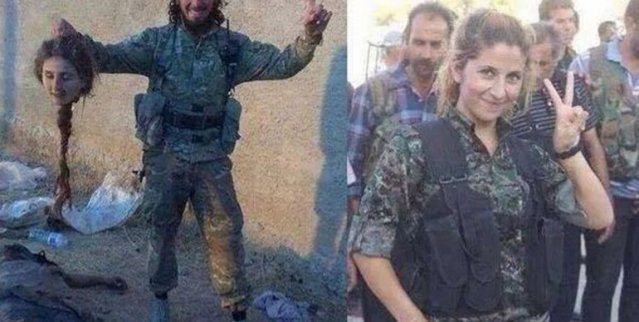
Es Rehana, una chavalita kurda que se unió a las YPJ y se
convirtió en emblema de la revolución kurda y la lucha de ese pueblo por su
supervivencia.
A mí me emociona ver cómo en esa parte del mundo, hay
mujeres que se revelan al destino de un objeto, pasivo y paciente, toman un
arma y defienden su cuerpo y su tierra contra los que pretendan hollarlo.
Exigen los mismos derechos que los hombres y están dispuestas a afrontar los
mismos peligros. Hoy que todo progre de mierda reivindica las bondades del
islam (sin someterse), yo muestro mi admiración al proyecto de tolerancia y
justicia social que están desarrollando contra viento y marea los kurdos.
Qué se le va a hacer, soy poco de modas. Ni pienso dejarme
barbita de gilipollas, a llevar las botas por fuera de los pantalones como un
monito, ni a estas alturas es de esperar que cambie mis principios. El que
mande a la mujer a la cocina, es mi enemigo. El que quiera imponer un credo,
una obediencia debida a una autoridad autocrática, es mi enemigo. El que
realiza una limpieza étnica, exterminando a los de fuera de su grupo étnico y/o
religioso es enemigo de toda la Humanidad y debe ser derrotado. Yo no
contemporizo con el fascismo, por mucho que luzca exótico con su chilaba: hasta
enterrarlos en el mar.
También son curiosas las carambolas de la historia; quién me
iba a decir tan sólo hace unos meses que tendría que ser Rusia, de nuevo, la
que lleve el peso de aplastar el fascismo en su versión más fanática y
genocida. Verdaderamente extraña, esta guerra…
Además, es que me resulta especialmente detestable ese
buenismo de teletubbi, porque es el mismo cinismo con que los países europeos
aislaron a la República en el 36. Con la palabra paz en la boca (y merced a una
intensa labor diplomática del Vaticano) negaron suministros a la joven
democracia, abandonándola desarmada (porque las armas las tenía el ejército
sublevado) en manos del fascismo. ¡Canallas! ¿Y lo mismo también pretendemos
hacer con Rojava? ¿Imponerles un embargo de armas, como propugnan los bobitos
de Podemos y su pensamiento mágico? No sólo la aviación no puede destruir los
carros y piezas de artillería islamista, sino que encima negamos a las YPG la
posibilidad de armarse. ¿Ignorancia o hipocresía criminal, la del puto coletas
y su compañero aniñado? Antes de echar la boca a pastar, hay que medir las
consecuencias de lo que decimos, más si te postulas para gobernar.
¡Ah! Se me olvidaba comentarlo. Rehana, el ángel de Kobanî,
fue presuntamente capturada por los mujaidines. Difundieron esta foto en sus
redes sociales:
Como se había convertido en una celebridad, hay tanto empeño
de unos en matarla como de otros en que esté viva, así que bien pudiera ser
ella, bien pudiera ser otra joven. Ahora bien, que sepáis que es el destino al
que estáis abocando a los kurdos sirios con vuestro infantilismo.
¿Guerra contra el fascismo? ¡SÍ! ¡Por supuesto, donde sea,
adopte la forma que adopte!
CODA: ¡Ah! Albertito…Pablete…no esperéis que os acompañe al
país de la piruleta de donde pretendéis venir. Las tonterías, tienen un límite.
Llegar a pagar a los acreedores la inmensa deuda me parece que es un plan demasiado ambicioso -quizás no tanto, al parecer alguien ha echado las cuentas y si cada ciudadano europeo pusiera 3€ se liquidaba totalmente-. Ésto me hace recordar a Lola Flores aunque claro, nada tienen que ver. Lo suyo sería que los cabronazis que se han llevado la pasta o se la han gastado en avioncitos y tanques lo devolvieran.
En fin, para lo que puede servir el dinero que se recaude en esta cuenta a una Grecia en situación de "corralito" es para pagar las nóminas a los funcionarios y las pensiones, sólo por eso creo que merece la pena rascarse el bolsillo.
As it happened – Yanis Varoufakis’ intervention during the 27th June
2015 Eurogroup Meeting Posted on June 28, 2015 by yanisv
The Eurogroup Meeting of 27th June 2015 will not go
down as a proud moment in Europe’s history. Ministers turned down the
Greek government’s request that the Greek people should be granted a
single week during which to deliver a Yes or No answer to the institutions’
proposals – proposals crucial for Greece’s future in the Eurozone. The
very idea that a government would consult its people on a problematic
proposal put to it by the institutions was treated with incomprehension
and often with disdain bordering on contempt. I was even asked: “How
do you expect common people to understand such complex issues?”. Indeed,
democracy did not have a good day in yesterday’s Eurogroup meeting! But nor did
European institutions.
After our request was rejected, the Eurogroup
President broke with the convention of unanimity (issuing a statement without
my consent) and even took the dubious decision to convene a follow up meeting
without the Greek minister, ostensibly to discuss the “next steps”.
Can democracy and a monetary union coexist? Or must
one give way? This is the pivotal question that the Eurogroup has decided to
answer by placing democracy in the too-hard basket. So far, one hopes.
Intervention by Yanis Varoufakis, 27th June 2015
Eurogroup Meeting
Colleagues,
In our last meeting (25th June) the institutions tabled
their final offer to the Greek authorities, in response to our proposal for a
Staff Level Agreement (SLA) as tabled on 22nd June (and signed
by Prime Minister Tsipras). After long, careful examination, our government
decided that, unfortunately, the institutions’ proposal could not be accepted.
In view of how close we have come to the 30th June deadline,
the date when the current loan agreement expires, this impasse of grave concern
to us all and its causes must be thoroughly examined.
We rejected the institutions’ 25th June proposals
because of a variety of powerful reasons. The first reason is the combination
of austerity and social injustice they would impose upon a population devastated
already by… austerity and social injustice. Even our own SLA proposal (22nd June)
is austerian, in a bid to placate the institutions and thus come closer to an
agreement. Only our SLA attempted to shift the burden of this renewed austerian
onslaught to those more able to afford it – e.g. by concentrating on increasing
employer contributions to pension funds rather than on reducing the lowest of
pensions. Nonetheless, even our SLA contains many parts that Greek society
rejects.
So, having pushed us hard to accept substantial new austerity, in the
form of absurdly large primary surpluses (3.5% of GDP over the medium term,
albeit somewhat lower than the unfathomable number agreed to by previous Greek
governments – i.e. 4.5%), we ended up having to make recessionary trade-offs
between, on the one hand, higher taxes/charges in an economy where those who
pay their dues pay through the nose and, on the other, reductions in
pensions/benefits in a society already devastated by massive cuts in basic
income support for the multiplying needy.
Let me say colleagues what we had already conveyed to the institutions
on 22nd June, as we were tabling our own proposals: Even this
SLA, the one we were proposing, would be extremely onerous to pass through
Parliament, given the level of recessionary measures and austerity it entailed.
Unfortunately, the institutions’ response was to insist on even more
recessionary (aka parametric) measures (e.g. increasing VAT on hotels from 6%
to 23%!) and, worse still, on shifting the burden massively from business to
the weakest members of society (e.g. to reduce the lowest of pensions, to
remove support for farmers, to postpone ad infinitum legislation that offers
some protection to badly exploited workers).
The institutions new proposals, as expressed in their 25th June
SLA/Prior Actions document, would make a politically problematic package – from
the perspective of our Parliament – into a package that would extremely
difficult to push through our Parliamentary caucus. But this is not all. It
gets worse much worse than that once we take a look at the proposed financing
package.
What makes it impossible to pass the institutions’
proposal through Parliament is the lack of an answer to the question: Will
these painful measures at least give us a period of tranquillity during which
to carry out the agreed reforms and measures? Will a shock of optimism counter
the recessionary effect of the extra fiscal consolidation that is being imposed
on a country that has been in recession for 21 consecutive quarters? The answer
is clear: No, the institutions’ proposal is offering no such prospect.
This is why: The proposed funding for the next 5 months (see below for a
breakdown) is problematic in a variety of ways:
First, it makes no provision for the state’s arrears, caused by five
months of making payments without disbursements and of falling tax revenues as
a result of the constant threat of Grexit that has been wafting in the air, so
to speak.
Secondly, the idea of cannibalising the HFSF in order to repay the ECB’s
SMP-era bonds constitutes a clear and present danger: These monies were
earmarked, correctly, for strengthening Greece’s fragile banks, possibly
through an operation that deals with their mountainous NPLs that eat into their
capitalisation. The answer I have been given by senior ECB officials, whose
name will remain unsaid, is that, if need be, the HFSF will be replenished to
cope with the banks’ capitalisation needs. And who will do the replenishing?
The ESM, is the answer I was given. But, and this is a gigantic but, this is
not part of the proposed deal and, moreover, it could not be part of the deal
as the institutions have no mandate to commit the ESM in this manner – as I am
sure Wolfgang will remind us all. And, moreover, if such a new arrangement
could be made, why then is our sensible, moderate, proposal of a new
ESM facility for Greece that helps shift SMP liability from the ECB to the ESM not discussed? The answer “we will
not discuss it because we will not discuss it” will be very hard for me to
convey to my Parliament, together with another package of austerity.
Thirdly, the proposed disbursements’ schedule is a minefield of reviews
– one per month – that will ensure two things. First, that the Greek government
will be immersed every day, every week in the review process for five long
months. And well before these five months expire, we shall enter into another
tedious negotiation over the next program – since there is nothing in the
institutions’ proposal capable of inspiring even the faintest of hopes that at
the end of this new extension Greece can stand on its own two feet.
Fourthly, given that it is abundantly clear that our debt will remain
unsustainable by the end of the year, and that market access will remain as
distant then as it is now, the IMF cannot be counted upon to disburse its
share, the 3.5 billion that the institutions are counting as part of the
funding package on the table.
These are solid reasons why our government does not consider it has a
mandate to accept the institutions’ proposal or to use its majority in
Parliament in order to push it through and onto the statutes.
At the same time, we do not have a mandate to turn down the
institutions’ proposals either, cognizant of the critical moment in history we
find ourselves in. Our party received 36% of the vote and the government as a
whole commanded a little more than 40%. Fully aware of how weighty our decision
is, we feel obliged to put the institutions’ proposal to the people of Greece.
We shall endeavour to spell out to them fully what a Yes to the Institutions’
Proposal means, to do the same regarding a No vote, and then let them decide.
For our part we shall accept the people’s verdict and will do whatever it takes
to implement it – one way or another.
Some worry that a Yes vote would be a vote of no confidence in our
government (as we shall be recommending a No vote), in which case we cannot
promise to the Eurogroup that we shall be in a position to sign and implement
the agreement with the institutions. This is not so. We are committed
democrats. If people gives us a clear instruction to sign up on the
institutions’ proposals, we shall do whatever it takes to do so – even if it
means a reconfigured government.
Colleagues, the referendum solution is optimal for all, given the
constraints we face.
If our government were to accept the
institutions’ offer today, promising to push it through Parliament
tomorrow, we would be defeated in Parliament with the result of a new
election being called within a very long month – then, the delay, the
uncertainty and the prospects of a successful resolution would be much,
much diminished.
But even if we managed to pass the
institutions’ proposal through Parliament, we would be facing a major
problem of ownership and implementation. Put simply, just as in the past
the governments that pushed through policies dictated by the institutions
could not carry the people with them, we too would fail to do so.
On the question that will be put to the Greek people, much has been said
about what it should be. Many of you tell us, advise us, instruct us even, that
we should make it a Yes or No question on the euro. Let me be clear on this.
First, the question was formulated by the Cabinet and has just been passed
through Parliament – and it is “Do you accept the institutions’ proposal as it
was presented to us on 25th June in the Eurogroup?” This is the
only pertinent question. If we had accepted that proposal two days ago, we
would have had a deal. The Greek government is now asking the electorate to
answer the question you put it to me Jeroen – especially when you said, and I
quote, “you can consider this, if you wish, a take or leave it proposal”. Well,
this is how we took it and we are now honouring the institutions and the Greek
people by asking the latter to deliver a clear answer on the institutions’
proposal.
To those who say that, effectively, this is a referendum on the euro, my
answer is: You may very well say this but I shall not comment. This is your
judgement, your opinion, your interpretation. Not ours! There is a logic to
your view but only if there is an implicit threat that a No from the Greek
people to the institutions’ proposal will be followed up by moves to eject
Greece, illegally, out of the euro. Such a threat would not be consistent with
basic principles of European democratic governance and European Law.
To those who instruct us to phrase the referendum question as a
euro-drachma dilemma, my answer is crystal clear: European Treaties make
provisions for an exit from the EU. They do not make
any provisions for an exit from the Eurozone. With good reason, of course, as
the indivisibility of our Monetary Union is part of its raison d’ etre.
To ask us to phrase the referendum question as a choice involving exit from the
Eurozone is to ask us to violate EU Treaties and EU Law. I suggest to anyone
who wants us, or anyone else, to hold a referendum on EMU membership to
recommend a change in the Treaties.
Colleagues,
It is time to take stock. The reason we find ourselves in the present
conundrum is one: Our government’s primary proposal to you and the
institutions, which I articulated here in the Eurogroup in my first ever
intervention, was never taken seriously. It was the suggestion that common
ground be created between the prevailing MoU and our new government’s program.
For a fleeting moment, the 20thFebruary Eurogroup statement raised
the prospect of such common ground – as it made no reference to the MoU and
concentrated on a new reform list by our government that would be put to the
institutions.
Regrettably, immediately after the 20th of February the
institutions, and most of colleagues in this room, sought to bring the MoU back
to the centre, and to reduce our role in marginal changes within the MoU. It is
as if we were told, to paraphrase Henry Ford, that we could have any reform
list, any agreement, as long as it was the MoU. Common ground was thus
sacrificed in favour of imposing upon our government a humiliating retreat.
This is my view. But it is not important now. Now it is up to the Greek people
to decide.
Our task, in today’s Eurogroup, ought to be to pave the ground for a
smooth passage to the referendum of 5th July. This means one
thing: that our loan agreement be extended by a few weeks so that the
referendum takes place in conditions of tranquillity. Immediately after 5th July,
if the people have voted Yes, the institutions’ proposal will be signed. Until
then, during the next week, as the referendum approaches, any deviation from
normality, especially in the banking sector, will be invariably interpreted as
an attempt to coerce Greek voters. Greek society has paid a hefty price,
through huge fiscal contraction, in order to be part of our monetary union. But
a democratic monetary union that threatens a people about to deliver their
verdict with capital controls and bank closures is a contradiction in terms. I
would like to think that the Eurogroup will respect this principle. As for the
ECB, the custodian on our monetary stability and of the Union itself, I have no
doubt that, if the Eurogroup takes a responsible decision today to accept the request for an extension of our loan
agreement that I am now tabling, it will do what it takes to give the Greek people a few more days to
express their opinion.
Colleagues, these are critical moments and the decisions we make are
momentous. In years to come we may well be asked “Where were you on the 27th of
June? And what did you do to avert what happened? At the very least we should
be able to say that: We gave the people who live under the worst
depression a chance to consider their options. We tried democracy as a means of
breaking a deadlock. And we did what it took to give them a few days to do so.
POSTSCRIPT – The day the Eurogroup President broke with the
tradition of unanimity and excluded Greece from a Eurogroup gathering at will
Following my intervention (see above) the Eurogroup President rejected
our request for an extension, with the support of the rest of the members, and
announced that the Eurogroup would be issuing a statement placing the burden of
this impasse on Greece and suggesting that the 18 ministers (that is the 19
Eurozone finance ministers except the Greek minister) reconvene later to
discuss ways and means of protecting themselves from the fallout.
At that point I asked for legal advice, from the secretariat, on whether
a Eurogroup statement can be issued without the conventional unanimity and
whether the President of the Eurogroup can convene a meeting without inviting
the finance minister of a Eurozone member-state. I received the following
extraordinary answer: “The Eurogroup is an informal group. Thus it is not bound
by Treaties or written regulations. While unanimity is conventionally adhered
to, the Eurogroup President is not bound to explicit rules.” I let the reader
comment on this remarkable statement.
For my part, I concluded as follows: Colleagues, refusing to extend the loan agreement for a few weeks, and for the purpose of giving the Greek people an opportunity to deliberate in peace and quiet on the institutions’ proposal, especially given the high probability that they will accept these proposals (contrary to our government’s advice), will damage permanently the credibility of the Eurogroup as a democratic decision making body comprising partner states sharing not only a common currency but also common values.






.jpg)

